You can play three times a week, own six paddles and still keep losing the same points for the same reasons.
Because nobody ever explained what to do when you're down 8–10…where to stand when your partner gets pulled wide…why the fifth shot can matter as much as the third…or how to discover an opponent's weakness before the fifth point is played.
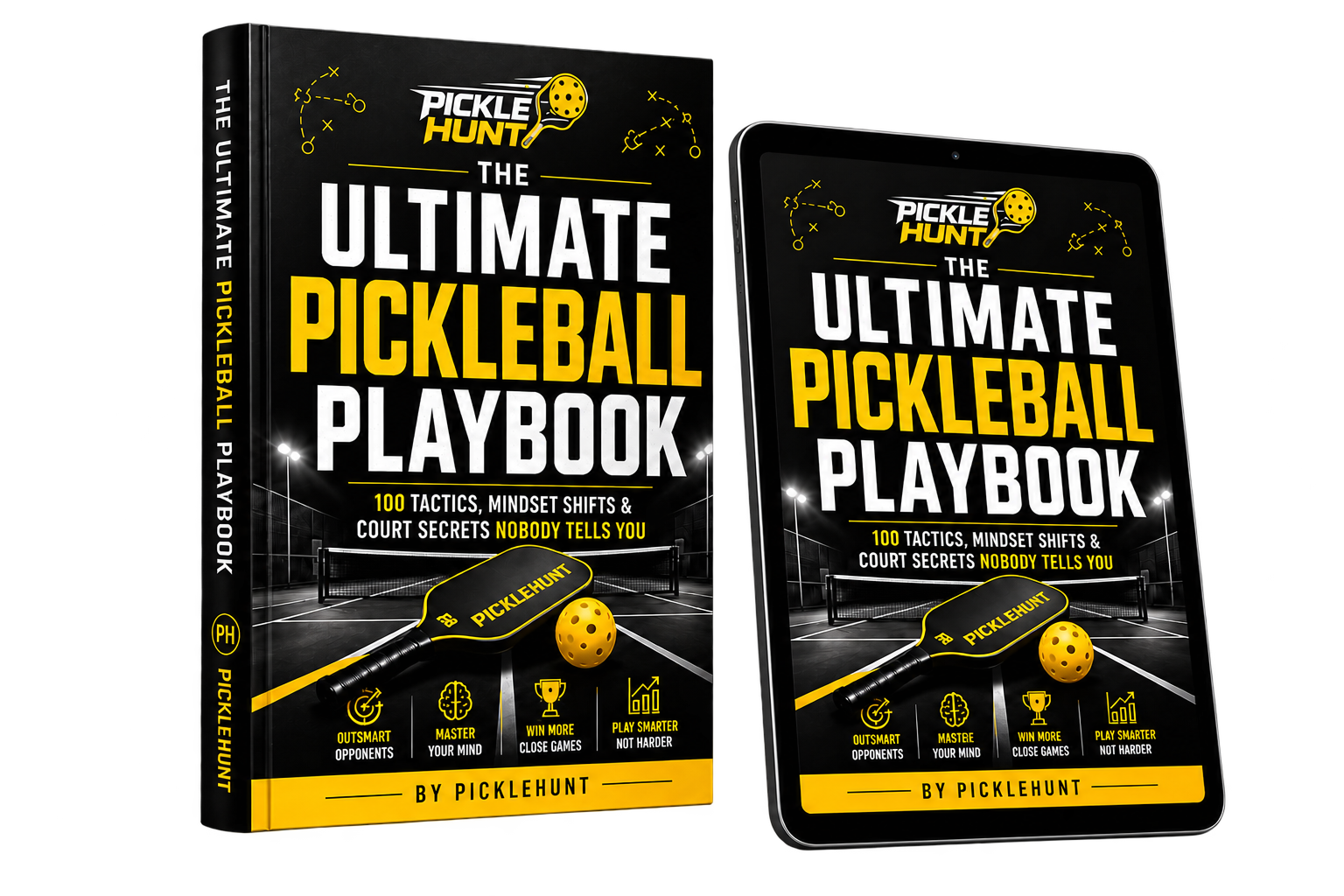
The Ultimate Pickleball Playbook reveals 100 proven tactics, mindset shifts and court secrets you can take into your very next match.
You were playing well.
Then you missed an easy volley.
You carried that mistake into the next point. Your grip tightened. Your feet stopped moving. You rushed a shot you normally make…and suddenly the score went from 8–6 to 8–10.
Now you're no longer playing the ball.
You're playing the score.
You're replaying the mistake.
And you're trying to win four points with one swing.
That game wasn't lost because you forgot how to play pickleball.
It was lost because nobody taught you how to reset between points, slow your brain down under pressure and stop one mistake from becoming momentum for the other team.
That's only Secret #1.
There are 99 more inside the playbook.
This book won't spend ten pages explaining what a dink is.
It will show you why standing directly on the kitchen line can steal your reaction time…why the middle ball must be claimed before hesitation appears…and why a deep return usually creates more trouble than a fast one.
It will teach you how to disrupt a team that wants to play fast, target the hip that creates instant forehand-backhand confusion and recognize the moment a rally needs to be reset instead of forced.
These are the details experienced players often learn only after years of losing the same kind of point.
Now you can learn all 100 in one playbook.
Get the complete playbookUse between-point routines, pre-serve rituals and pressure resets to stay steady when the score gets uncomfortable.
Learn where to stand, when to slide and how to avoid the court positions that force you into desperate shots.
Create simple rules for the middle, lobs, poaching and movement so you and your partner stop surprising each other.
Find the weak backhand, disrupt their rhythm and keep using the pattern that works until they finally prove they can stop it.
Stay calm at 8–10, let go of mistakes faster and build simple routines that keep your mind in the point you're actually playing.
Discover why “safe” positions become traps, how to move with every shot and where to stand so the game starts feeling slower.
Decide who owns the middle, who covers the lob and how to move together like an invisible rope connects you and your partner.
Serve with a plan, hide your return intention, prioritize depth and use the first two shots to create the rally you want.
Control the kitchen through patience, stable feet, compact swings and the ability to push, block or reset at the correct moment.
Choose between the drop and drive in one second, target the hip, stop chasing hero shots and run winning patterns repeatedly.
Slow down frantic teams, break comfortable rhythms, stop momentum runs and use the time between points as a tactical weapon.
Read their feet, eyes, balance and habits—then create the exact ball, movement or pressure that makes their weakness appear.
Track what truly costs you points, give every repetition a target and make practice uncomfortable enough to survive match pressure.
Manage nerves, energy and difficult calls while using routines that keep your body and mind ready from the first match to the last.
The playbook teaches you what to notice. The Match-Day Toolkit helps you capture it, act on it and carry it into your next game. Print the pages. Keep them in your bag. And stop allowing the most useful lessons from today's match to disappear before tomorrow's practice.
Prepare your body, equipment and attention before the first point so you don't spend half the opening game trying to wake up.
Use warm-up and the first few points to record which backhand breaks down, which movement looks uncomfortable and which pattern produces weak replies.
Choose your serve targets, return priorities, partnership rules and first tactical adjustment before pressure begins making decisions for you.
See where points begin arriving in clusters and identify the exact pattern that changed the direction of the game.
A simple courtside reminder for the moment you're down 8–10, your partner looks nervous and every shot suddenly feels urgent.
Write what worked, what failed and the one weakness your next practice must address—in three focused minutes.
The player with the forehand angle takes the middle ball. Agree before the game, commit instantly and stop watching playable balls land between two hesitant paddles.
Behind the baseline? Drop. Opponent off balance or trapped mid-court? Drive. Still uncertain? Use the higher-percentage drop and earn your way forward.
While everyone else is casually getting loose, test the backhand, feed low balls and observe movement. Your opponent may reveal the strategy before the match begins.
The next time you're down 8–10, will you rush—or use the reset routine?
When your partner gets pulled wide, will the middle open—or will you already be sliding to support?
When one opponent starts rushing, will you match their chaos—or slow the game down and watch them unravel?
When the same weak backhand appears for the fifth time, will you change targets to be polite—or keep feeding it until they prove they can handle it?
The situations aren't new. Your response can be.
No. This is for recreational players who already understand the rules and basic shots but want to make better decisions during real matches. If you can play but still feel mentally rushed, positionally uncertain or tactically stuck, this was written for you.
You'll receive the 77-page Ultimate Pickleball Playbook containing 100 secrets across ten chapters, plus the complete printable Match-Day Toolkit.
No. It is a digital PDF delivered immediately after purchase. Read it on your phone, tablet or computer, and print any toolkit pages you want to carry to the court.
No. Start with the chapter connected to your biggest current problem. Choose one or two secrets, use them in your next match and return when you're ready for the next adjustment.
Yes. The doubles chapter focuses specifically on partnership movement and communication. The other chapters—mental strength, positioning, serve and return, net play, shot selection, tempo, opponent analysis, practice and tournaments—contain strategies useful in both formats.
Videos usually solve one isolated problem at a time. This playbook gives you a complete, organized system covering the mental, tactical, positional and practice decisions that connect one point to the next.
Read the relevant chapters and apply the strategies in your next three matches. If you don't feel a genuine difference in what you notice, how you decide and how you respond under pressure, contact us within 30 days and request a refund.
The regular price is $47. The complete digital playbook and Match-Day Toolkit are currently available together for $27.
Maybe it's the ritual that stops one mistake from becoming five.
Maybe it's the positioning shift that makes the court feel smaller.
Maybe it's the serve placement that creates the return your partner has been waiting for.
Or maybe it's the secret that helps you finally close the game at 10–10.
You won't know until you see what has been missing.
Unlock all 100 secrets for $27